China vs Vietnam Leather Manufacturing: Comparison for Brands | Best Country for Leather Product Manufacturing
Summary: China vs Vietnam Leather Manufacturing
- China is better for speed, complex products, and scaling across multiple SKUs
- Vietnam is better for cost efficiency and stable, repeat production
- Startups usually start in China for flexibility
- Growing brands often shift cost-sensitive or standardized products (such as PU bags or simpler constructions) to Vietnam for better cost control
- Large brands often prioritize China for high-quality, complex, or premium leather products, while using Vietnam selectively for cost-sensitive or standardized programs
When choosing between China and Vietnam for leather product manufacturing, brands often compare labor costs, production capacity, supplier networks, and export advantages. In general, China is often more suitable for brands that need faster development, stronger supply chain coordination, and easier scaling across multiple SKUs. Vietnam can be a good option for brands with more stable product structures, clearer forecasting, and a stronger focus on labor cost efficiency or tariff planning. The better choice usually depends not only on headline cost, but also on how your products are built, how often they change, and how much flexibility your sourcing strategy requires.
Over the past years, Vietnam has emerged as a key competitor of China in terms of leather product manufacturing. China has been a global leader in leather goods production for decades, establishing extensive factory networks and integrated supply chains that serve brands in key markets. However, since the early 2000s, Vietnam has gradually grown its footprint and started attracting more international manufacturing projects, becoming an important player in the China vs Vietnam leather manufacturing cost debate.
When considering leather product manufacturing options, brands often face the decision of choosing between China and Vietnam leather manufacturing. Both countries have strong manufacturing capabilities, but the production environments are quite different. By understanding these differences, brands can make strategic decisions that align with their product plans and long-term supply chain strategies.
6 Differences Between China and Vietnam Leather Manufacturing for Brands
When comparing China vs Vietnam leather manufacturing, brands typically consider factors such as sourcing strategy, production needs, and long-term supply chain planning. Several key factors shape these differences. The most important ones include:
- Manufacturing Infrastructure and Supply Chain: China vs Vietnam Leather Manufacturing Comparison
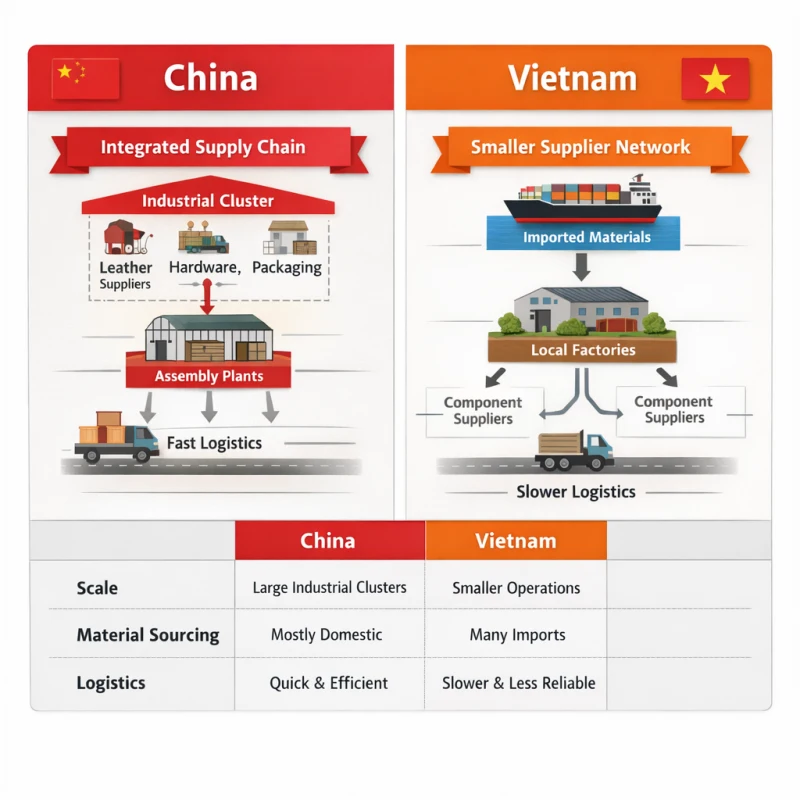
China offers a fully integrated manufacturing ecosystem that is often ideal for brands that need a robust supply chain. Vietnam, on the other hand, is often more suitable for brands with simpler product requirements or established supplier relationships.
China’s leather manufacturing industry operates within large industrial clusters where suppliers for leather, hardware, packaging, and other components work within the same region. This concentration allows factories to source materials quickly and coordinate production without relying heavily on external suppliers. Vietnam’s manufacturing sector is growing, but the supplier ecosystem remains smaller, with some factories still depending on imported materials for certain components.
For brands, this difference goes beyond purchasing speed. It can also affect how efficiently a factory responds when a material is changed, a hardware finish is updated, or a packaging detail needs revision during sampling or production. In China, these adjustments are often easier to coordinate because the supplier network is denser and more responsive. In Vietnam, the process can still work well, but in some cases it may require more time and planning, especially when materials are sourced from outside the country.
This is why supply chain maturity should be assessed not only from a cost perspective, but also from a flexibility and control perspective. A lower unit price may not always offset longer coordination time if a product is still being refined or if the brand changes specifications frequently.
- Labor Cost and Workforce Skill in Leather Product Manufacturing
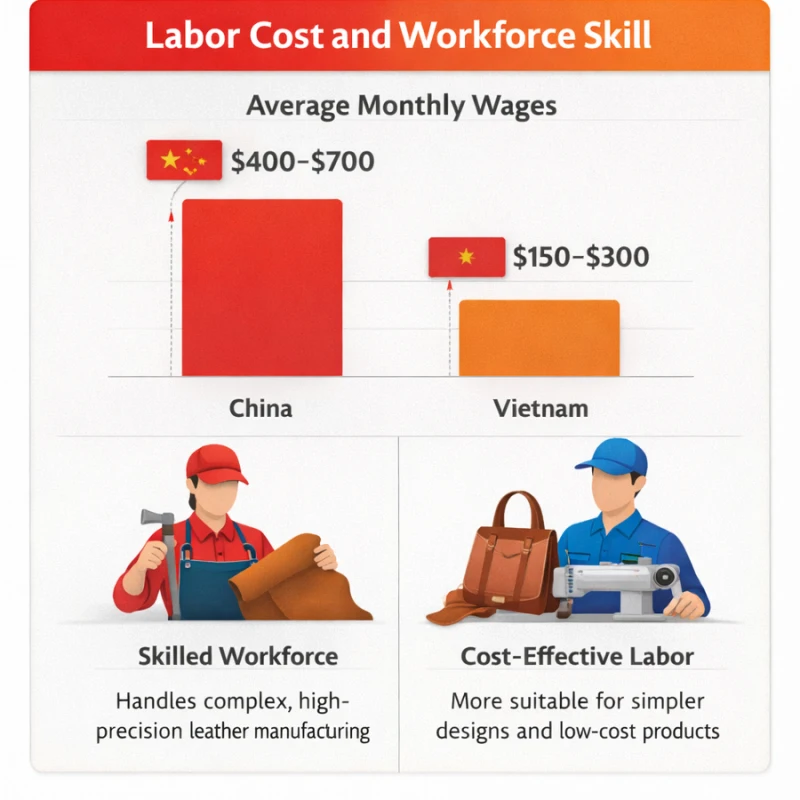
Vietnam is often more cost-effective for brands prioritizing lower manufacturing costs, while China is often better for those requiring highly experienced production teams and skilled labor.
Labor wages in Vietnam are generally lower than in China. In many Vietnamese regions, factory wages typically range between $150 and $300 per month, while Chinese wages often range from $400 to $700 per month, depending on skill level and location.
However, labor cost alone does not tell the full story. Leather goods are not purely labor-driven products. Construction complexity, reinforcement methods, edge finishing, hardware installation, defect control, and final consistency all influence the actual production result. In many cases, a more experienced workforce may reduce rework, improve efficiency, and lower hidden costs that do not appear in a simple labor comparison.
China has a long history in leather manufacturing, and many factories have teams with stronger experience in handling complex structures, premium finishing standards, and export requirements. Vietnam also has skilled labor and continues to improve, but experience levels may vary more depending on factory type, product category, and the maturity of the production line.
For brands producing simpler, repeatable items, Vietnam’s labor advantage may be more meaningful. For brands producing premium handbags, structured bags, or complex small leather goods, China’s workforce experience may justify the higher labor cost.
- Production Capacity and Scalability: China Leather Production Advantages
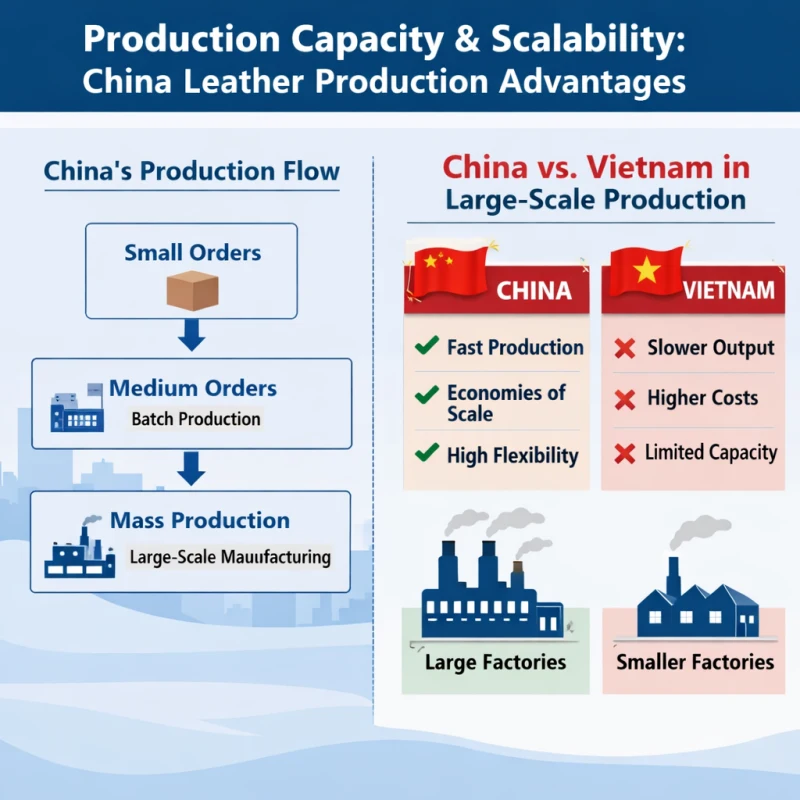
China is often better for brands needing to scale production quickly, while Vietnam often works best for companies with stable production programs.
Large industrial clusters in China give manufacturers a significant advantage in scaling production. In several manufacturing cities, thousands of factories operate within the same ecosystem, producing leather goods, hardware, packaging, and related components. This dense network allows brands to begin with smaller test orders and expand output quickly.
Scalability is not only about factory floor space or the number of sewing lines. It also depends on how well the surrounding supplier network can support volume increases. If one supplier cannot keep up with demand, it is often easier in China to identify alternatives in the same industrial area. This gives brands more room to test, scale, and adjust without rebuilding the entire sourcing structure.
Vietnam can support stable production as well, particularly for established products with more predictable demand. For brands with standardized designs and clearer forecasts, Vietnam may provide a dependable production base. However, compared with China, Vietnam’s manufacturing base is smaller, which may make it less flexible when a brand wants to scale quickly across multiple programs or respond rapidly to seasonal demand changes.
This difference is especially important for brands balancing trial orders with future growth. China is often stronger when a brand wants to test, learn, revise, and then scale within one integrated ecosystem.
- Lead Times and Production Speed: Speed in China vs Stability in Vietnam
China is often better for brands that need faster product development and shorter lead times, while Vietnam is often more suited for planned production schedules.
China’s manufacturing ecosystem allows for quick transitions from sampling to production. Sample development typically takes 1–2 weeks, and full production runs often take 4–8 weeks, depending on product complexity and order size.
Lead time, however, is not just a factory issue. It also reflects how quickly the full supply chain can react when something changes. If a zipper color is unavailable, if leather needs to be matched again, or if packaging dimensions need revision, China’s integrated ecosystem often makes the adjustment process smoother. That is one reason many brands continue to use China for product development and early-stage production even when they are also evaluating Vietnam for more mature bulk programs.
Vietnam can also offer stable timelines, especially for repeat orders with fixed materials and fewer revisions. But production preparation may take longer when external suppliers are involved or when multiple changes happen before final approval. In those cases, the difference is usually less about factory capability and more about supplier coordination structure.
For brands whose business depends on faster launch cycles, this speed advantage can be commercially important. For brands operating on steady production calendars with fewer changes, Vietnam may still be a practical fit.
- Quality Control and Manufacturing Consistency: China Leather Production Standards
Large production runs often favor China. While Vietnam also delivers quality, maintaining consistency across very high volumes is often easier in China’s integrated manufacturing ecosystem.
Chinese factories have decades of experience developing structured quality control systems. Multiple inspection stages are common, starting with raw material checks, continuing with in-line inspections, and concluding with final inspection before shipment.
For many brands, the issue is not whether one good sample can be made. The bigger question is whether the same result can be maintained across repeat orders, higher volumes, and different material batches. This is where process maturity matters. China’s longer export experience, stronger supplier coordination, and more developed QC systems often make consistency easier to manage, especially for structured bags, premium leather goods, and programs with tight visual requirements.
Vietnam can also produce strong quality, and some factories perform very well, especially for stable product categories. However, maintaining the same level of consistency may require more hands-on coordination depending on the factory, the sourcing model, and the complexity of the product. For brands with demanding quality standards, this should be evaluated at both the country level and the factory level.
- Trade Agreements and Export Advantages: Vietnam vs China Export Benefits
Vietnam offers tariff advantages in certain export markets, while China remains stronger in global logistics and shipping infrastructure.
Vietnam’s expanding network of free trade agreements, including the EU-Vietnam Free Trade Agreement (EVFTA), helps reduce or eliminate tariffs for many exported goods entering participating markets.
China, however, continues to hold major advantages in logistics infrastructure. Port systems, shipping frequency, freight capacity, and overall export support remain highly developed. This can make a meaningful difference for brands managing mixed shipments, tighter delivery schedules, or more complex global replenishment programs.
Brands should therefore evaluate tariff benefits and logistics capability together. A tariff advantage may improve landed cost in one market, but shipping flexibility, consolidation efficiency, and supplier responsiveness may still affect the total sourcing outcome. Depending on the destination market and shipping pattern, one advantage may matter more than the other.
Here’s a table summarizing the key points discussed in the article comparing China vs Vietnam Leather Manufacturing:
| Criteria | China | Vietnam |
| Manufacturing Infrastructure and Supply Chain | Fully integrated, large industrial clusters with a complete supply chain for fast sourcing of materials | Growing, but smaller supplier ecosystem, relying on imported materials for some components |
| Labor Cost | Higher wages ($400–$700/month), but a highly skilled workforce for complex products | Lower wages ($150–$300/month), ideal for labor-intensive production |
| Workforce Skill | Highly skilled labor with decades of experience in leather production | Skilled workforce, but may require more coordination for quality control |
| Production Capacity and Scalability | Large industrial clusters allow for quick scaling and flexibility in production | Smaller scale but offers stable production for established products |
| Lead Times and Production Speed | Fast production cycles (1–2 weeks for samples, 4–8 weeks for full production) | Longer lead times due to setup time, but consistent and predictable output |
| Quality Control and Manufacturing Consistency | Well-established, structured quality control systems for high-volume production | Reliable quality but may require more coordination, especially for material sourcing |
| Trade Agreements and Export Advantages | Strong logistics infrastructure, but tariffs on exports to some markets, like the U.S. | Tariff benefits due to trade agreements (e.g., EVFTA for European markets) |
| Best for | Brands needing speed, scalability, and complex, high-quality production | Brands focusing on labor cost advantages and stable production for established product lines |
Cultural and Market Differences: China vs Vietnam in Leather Manufacturing
In addition to operational factors, understanding the cultural and market differences between China and Vietnam is crucial for brands that are entering these manufacturing regions. These cultural nuances influence how business negotiations are handled, how factories operate, and how communication flows between manufacturers and clients. Here are a few key areas where these differences stand out:
- Business Negotiations and Communication Styles
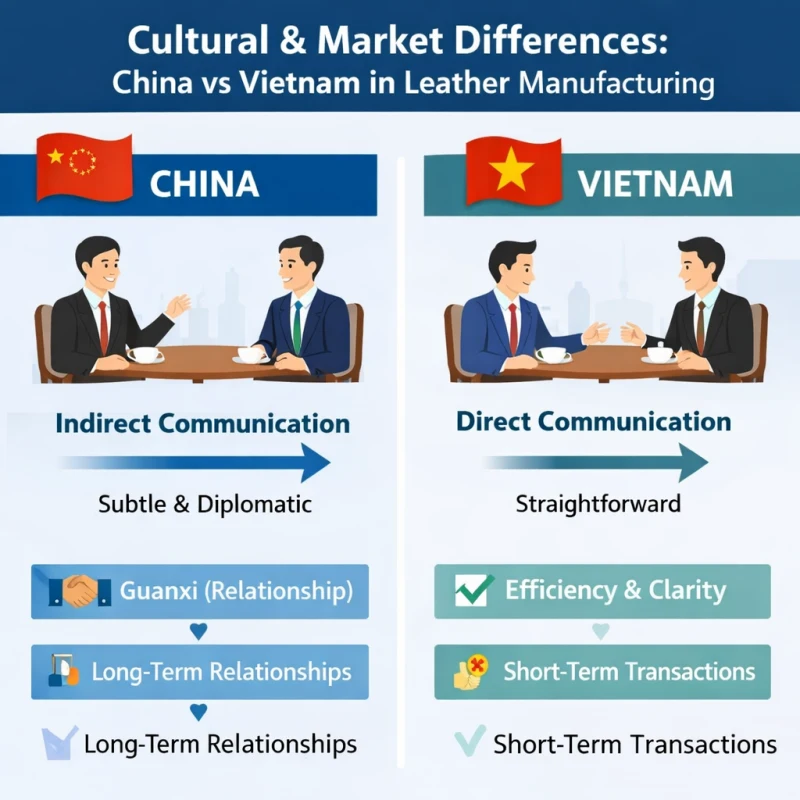
- China: Business negotiations in China tend to be formal and relationship-driven. The concept of “guanxi” (relationships) plays a significant role in business dealings. It’s common for Chinese manufacturers to prioritize long-term relationships, and negotiations can involve indirect communication and subtle bargaining.
· Vietnam: In Vietnam, business negotiations tend to be more direct and less hierarchical. The Vietnamese value clear and straightforward communication. Negotiations may be faster compared to China, and Vietnamese manufacturers may be more flexible in their approach.
- Factory Audits and Compliance
- China: Due to China’s extensive manufacturing experience, factory audits are often highly structured. It’s common for factories in China to have established processes for quality control and compliance.
· Vietnam: While factory audits in Vietnam are also rigorous, smaller factories may not always have the same level of experience with international certifications.
- Cultural Approaches to Problem-Solving
- China: Chinese manufacturers typically focus on speed and efficiency, while also placing strong emphasis on quality control, consistency, and increasing compliance with environmental and sustainability standards in production.
· Vietnam: Vietnamese manufacturers often focus on maintaining product consistency over time, with a careful approach to adjustments and stable production processes.
If you’re comparing suppliers and are not sure how your product fits into China or Vietnam production models, we can help review your design, materials, and order structure before you commit.
- Market Demand and Trends
- China: China’s manufacturing market is highly competitive, which has driven continuous improvements in quality, craftsmanship, and consistency. In addition, many factories now support eco-friendly materials and sustainable production standards, making China a key sourcing destination for both premium and environmentally conscious products.
· Vietnam: Vietnam’s manufacturing industry is growing rapidly, with increasing focus on cost efficiency and, in some cases, sustainable production. It can be a suitable option for brands prioritizing eco-friendly materials or cost-sensitive product lines.
How to Choose Between China and Vietnam Leather Product Manufacturing
Choosing between China and Vietnam often depends on how production is structured and how quickly demand is expected to grow. Both countries are capable of producing high-quality leather goods, but they support different manufacturing strategies.
For startups, flexibility usually matters more than pure labor savings. Early-stage brands often need faster sampling, easier revisions, and lower coordination risk while they test product-market fit. In many cases, China is the more practical starting point because it allows quicker adjustments, smaller development runs, and faster access to supporting suppliers.
For growing brands, the decision often changes once designs become stable and demand becomes more predictable. At that stage, cost control becomes more important, and Vietnam may become attractive for selected programs where materials, construction, and output planning are already more standardized.
For larger brands, the choice is often not either-or. Many companies divide production strategically, using China for product development, higher-complexity programs, and faster scaling, while using Vietnam for stable, high-volume production where processes are already proven. This blended approach is often less about choosing one country as universally better and more about assigning each country the role it performs best.
Still unsure about which manufacturing option is right for you?
We can help review the key differences and considerations based on your actual product structure, sourcing goals, and production priorities.
Key Takeaways for Brands
- China is often better for speed, scalability, and integrated supply chains.
· Vietnam is often better for labor cost advantages and tariff benefits.
· Startups often begin production in China.
· Growing brands often keep higher-quality or more complex products in China, while shifting cost-sensitive or simpler items (such as PU bags) to Vietnam.
· Large brands often prioritize China for premium products and quality consistency, while using Vietnam selectively for specific cost-driven programs.
Ready to start your leather production journey?
Whether you’re a startup looking for flexibility or a growing brand seeking stable production, we can help you navigate the best options in China or Vietnam.
Request a Quote to get started today!
Quick Decision Guide for Brands
| If you need… | Choose |
| Fast sampling & revisions | China |
| Lower labor cost | Vietnam |
| Complex leather bags | China |
| Simple or cost-sensitive products (e.g., PU bags) | Vietnam |
| Multi-SKU scaling | China |
| Tariff advantage (EU) | Vietnam |
Final Thoughts: Actionable Guidelines for Choosing Between China and Vietnam
Choosing between China and Vietnam for leather product manufacturing depends on a brand’s stage, product complexity, and cost structure. Here’s a more practical approach for different types of brands:
- For Startups: Focus on Flexibility and Product Development
Actionable Step: Start production in China for small batches, faster sampling, and easier adjustments during early-stage development. - For Growing Brands: Balance Quality and Cost
Actionable Step: Keep higher-quality or more complex leather products in China, while shifting cost-sensitive or simpler items (such as PU bags or basic constructions) to Vietnam for better cost control. - For Large Brands: Prioritize Quality and Strategic Allocation
Actionable Step: Many established brands continue to rely on China for premium products and consistent quality, while using Vietnam selectively for specific cost-driven or standardized programs.
Need expert advice for your leather manufacturing needs?
Our team can help review your product structure and recommend the most suitable production strategy based on your materials, design complexity, and target pricing.
If you’d like, we can review your product structure and suggest the most suitable production strategy based on your materials, design complexity, and target price — before you commit to sampling or bulk production.
FAQs about China vs Vietnam Leather Manufacturing
- What are the main differences between China and Vietnam for leather product manufacturing?
China offers a fully integrated supply chain and is often suitable for large-scale production and faster lead times, while Vietnam is often more cost-effective with lower labor costs and favorable trade agreements, making it suitable for stable long-term production. - Is Vietnam a good option for small leather goods production?
It can be. Vietnam’s lower labor costs and stable production environment can make it a good option for small leather goods like wallets and accessories, especially when producing in steady volumes. - Can I produce leather bags in both China and Vietnam?
Yes. Many brands split production between China for product development and faster scaling, and Vietnam for large-volume production, benefiting from lower labor costs and tariff advantages in the latter. - Which country often offers faster lead times, China or Vietnam?
China typically offers faster lead times due to its highly developed infrastructure and integrated supply chains, with production and sampling often completed in 4–8 weeks. Vietnam may take longer when programs rely on external suppliers for some materials. - Are labor costs lower in Vietnam than in China?
In general, yes. Labor costs in Vietnam are lower than in China, with wages in Vietnam often ranging from $150–$300 per month, while wages in China often range from $400–$700 per month, depending on the region and skill level. - How do trade agreements affect leather manufacturing in Vietnam?
Vietnam benefits from multiple trade agreements, such as the EU-Vietnam Free Trade Agreement (EVFTA), which can reduce or eliminate tariffs for leather goods exported to participating markets, making it a cost-effective option for brands targeting those regions. - Is China still a strong option for luxury leather goods?
Yes. China remains a strong choice for luxury leather goods due to its highly skilled workforce, advanced manufacturing capabilities, and ability to handle more complex production processes. - How should I evaluate which country is best for my leather products?
Evaluate your brand’s actual needs: speed, scaling, product development flexibility, labor cost, lead times, supplier network depth, and quality consistency. The better choice usually depends on how stable your product structure is and how much coordination flexibility you need. - What types of brands often benefit most from manufacturing in China?
Large brands, startups that need rapid prototyping, and companies requiring high-quality, complex leather goods with faster scaling needs often benefit most from China’s well-established infrastructure and supplier ecosystem.