Tote Bag vs Shoulder Bag: Key Differences and How Brands Choose
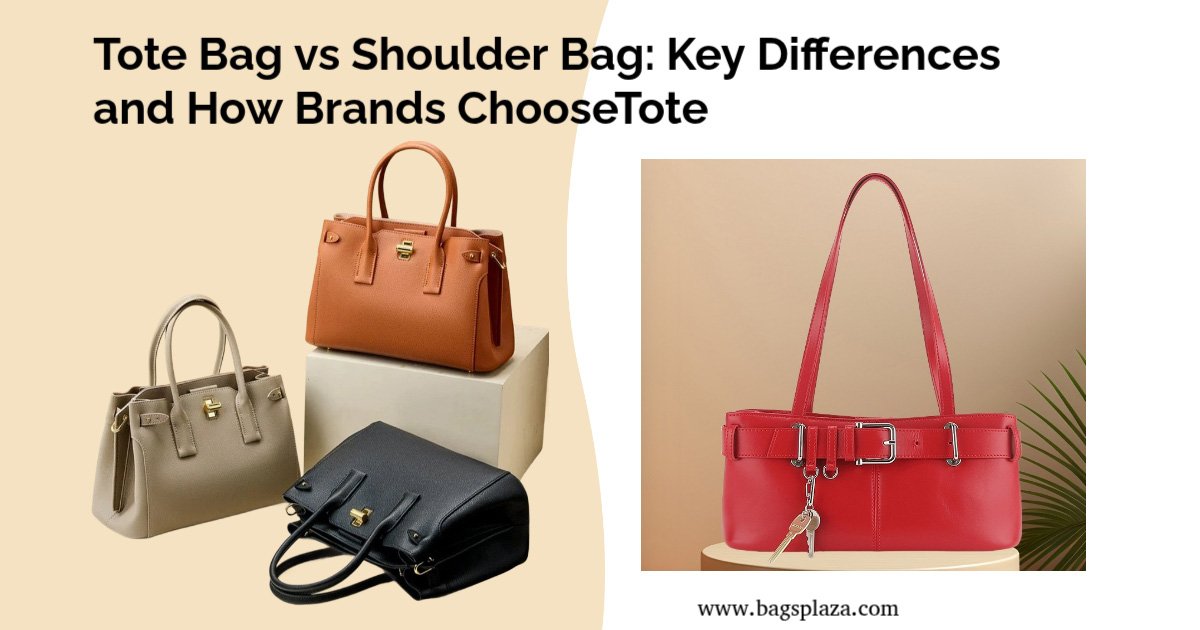
Choosing between a tote bag and a shoulder bag is not a debate about which silhouette is “better.” It is a brand decision. Each silhouette communicates a different message about lifestyle, product behavior, and merchandising role. When a brand commits to a tote, it usually commits to capacity, daily practicality, and repeat usage. When a brand commits to a shoulder bag, it usually commits to styling, polish, and a more intentional accessory identity.
For B2B buyers building a private label or wholesale program, this choice must connect to OEM/ODM feasibility, BOM structure, and repeat-order quality control. Category hub: https://bagsplaza.com/leather-bags/
Core Design Differences Buyers Evaluate
Use Scenario
Tote bags are built for “carry-many” behavior. The user opens the bag frequently, drops items in and out, and puts the bag down on desks, seats, counters, and floors. That set-down-and-reopen loop is the tote’s language. It fits scenarios where access speed matters and the bag needs to adapt to changing loads throughout the day. If you want an internal link to your tote silhouette page, use: https://bagsplaza.com/leather-bag-tote/
Shoulder bags are built for “stay-on-body” behavior. The bag is worn during motion and accessed without being set down as often. This is why shoulder styles show up strongly in professional routines between meetings, city movement, where the user wants the bag close and visible, and travel situations where the user wants controlled access while walking or queuing. For your shoulder bag category page, use: https://bagsplaza.com/leather-shoulderbags/
For buyers, the decision is rarely “tote or shoulder” in isolation—it’s about your customer mix and the role each silhouette plays in your assortment. If your audience is younger and style-led, prioritize shoulder bags as the lead category and use totes as secondary carry options. If your audience is office/commute-led, prioritize totes for daily capacity and structure, and add shoulder styles as a lighter, mobile alternative. A quick validation rule: high set-down frequency favors totes; high in-motion access favors shoulder bags.
Carry Experience
A tote is primarily designed for hand or forearm carry. Weight is supported through the grip, which makes access and release fast. The bag sits off the body, which fits short bursts of movement and frequent placement on surfaces. This also explains why totes can feel “easy” in the moment but become tiring with heavier loads over longer distances when handle drop, handle width, and edge comfort are not engineered for sustained carry.
A shoulder bag distributes weight through a strap resting on the shoulder or across the torso contact zone. Most shoulder designs sit closer to the body than totes, but stability depends on strap drop, strap width, anchor placement, and how the bag’s volume rests against the torso while walking. In buyer terms, totes win when access speed is the priority. Shoulder bags win when movement stability and carry comfort are the priority.
Silhouette and On-Body Look
Totes usually communicate their intent immediately. The open width, vertical proportions, parallel handles, and open-body presence signal function, everyday readiness, and utility-led lifestyle. Even when a tote is premium and structured, it often still reads as “this is a bag I can live in.”
Shoulder bags feel more considered. The compact footprint, strap presence, controlled edges, and closure line create a stylized, accessory-forward impression. Hardware becomes a major visual tool. Zipper pulls, turn locks, magnetic flaps, buckles, and edge details can shift the bag from minimal to statement. In brand language, a tote reads as functional lifestyle, while a shoulder bag reads as styled accessory.
Access and Capacity Behavior
A tote is typically designed around drop-in accessibility. The philosophy is “fits more.” The user loads variable items, sees contents quickly, and lives in a grab-and-go rhythm.
A shoulder bag is typically designed around “fits smarter.” Instead of maximizing open volume, it organizes essentials with defined compartments, structured interiors, and predictable retrieval. The user knows where the phone, keys, wallet, and daily items are, even if the total capacity is lower than a tote.
Security Level
Totes often prioritize convenience. Many use open tops, magnets, or simple closures that allow quick entry and exit. This works well in controlled environments such as offices, cars, and home routines where speed matters more than security.
Shoulder bags are more often built around closure systems and body positioning that prevent loss during movement. Zippers, flaps, turn locks, snaps, and magnetic closures are used not only as design features but also as functional controls. If you want a supporting internal article that reinforces “QC and security-minded construction,” link here: https://bagsplaza.com/how-to-ensure-quality-control-with-your-leather-bag-factory/
Strap and Handle System
A tote typically starts with short handles as its base identity. Adding a long strap can push it into a convertible category, but then the product must behave like a strap-based design. Anchor strength, strap drop, adjustability, and loaded comfort become non-negotiable.
Shoulder bags belong to the strap-based family from the beginning. That changes engineering priorities and failure modes. If hands-free carry is part of the brand promise, a shoulder or crossbody-ready design, or a true convertible tote with fully engineered anchors, should be treated as the base product.
Structure and Support Control
The divider is not the silhouette’s name. The divider is whether the design is access-led or closure-led. A tote can be structured or soft. A shoulder bag can also be soft or highly structured. What changes is how much shape stability the brand wants to signal, and how consistent that shape must remain across production runs and repeat orders. Shape stability affects reinforcement choices, material selection, and the QC checkpoints you must protect from day one.
Design Language: What Each Silhouette Signals
Visual Anchors
For tote products, the visual anchors are the open width, vertical ratio, handle position, and open-body look. This language communicates immediacy and function. For shoulder bags, the visual anchors are the strap, compact body shape, structured edges, closure line, and hardware. This language communicates intention and styling control. Totes feel immediate. Shoulder bags feel designed.
Brand Signals
A tote signals ease of use, mobility, and functionality. The message is that one bag can serve many parts of life without needing specialized choices. A shoulder bag signals styling, polish, and accessorizing. The message is that the bag is chosen to complete a look and reflect identity. Used correctly, the tote becomes the demand stabilizer and volume driver, while the shoulder bag becomes the identity amplifier.
Positioning and Channel Fit
A tote usually fits best when a brand is utility-led, everyday, and needs scale. It performs naturally in a broad assortment of environments and volume lifestyle retail because the buyer motive is frequently utility-driven and repeatable. The tote often becomes the anchor silhouette that brings customers into the line and stabilizes reorder cycles.
A shoulder bag fits best when a brand is style-led and image-focused. It performs naturally in curated retail and fashion-led assortments because buyer motive is styling-driven. This is also why shoulder bag selection is more sensitive to hardware finish, closure alignment, and visual consistency than tote programs tend to be.
Quick Decision Filter: Three Questions That Decide Fast
The first question is whether the purchase is driven by capacity or style. If capacity and variable load matter most, the tote is usually the base silhouette. If styling and look-completion drive the purchase, a shoulder bag usually becomes the lead silhouette.
The second question is whether the customer stays in motion and needs on-body control. If the user frequently sets the bag down and wants fast access, the tote aligns. If the user moves through transit, crowds, or travel, strap-based designs align, and the closure system must be engineered for movement, not just for convenience.
The third question is whether the business is lifestyle-volume or curated-fashion. Lifestyle retail often benefits from a tote-led lineup because it scales demand and supports broader audiences. Curated retail often benefits from a shoulder-led lineup because it concentrates identity and supports higher perceived value.
What Changes in BOM, Cost, and QC When You Choose Tote vs Shoulder
Silhouette choice has direct consequences for BOM structure, production rhythm, and QC risk. Tote bags often carry BOM weight in large panels, long edge-finishing runs, and load-bearing handle systems. Because totes experience variable loads and frequent set-down behavior, reinforcement decisions matter early. Handle anchor reinforcement, top edge stabilization, bottom structure, and body panel support must be designed to avoid sagging, twisting, and long-term deformation. In cost terms, totes often hide cost in material yield, panel size, and finishing length rather than hardware count.
Shoulder bags often carry BOM weight in smaller components, closure systems, and hardware. A shoulder bag’s perceived value depends heavily on consistent hardware finish, tight alignment of closure lines, and clean stitching and edge execution around high-visibility zones. In cost terms, shoulder bags concentrate cost in hardware, labor time on detailed assembly, and tighter tolerance requirements, especially when structured edges or flap closures are involved.
QC risk also differs. Tote QC commonly focuses on shape drift, handle orientation consistency, top-edge collapse, and bottom deformation under load cycles. Shoulder bag QC commonly focuses on anchor-point strength, strap adjustability consistency, closure alignment, and surface protection against hardware scratches. In practice, totes are punished by long-term loading and repeated handling. Shoulder bags are punished by small inconsistencies that become visually obvious.
If you want an internal link that supports OEM/ODM decision logic and improves keyword relevance for “OEM vs ODM leather bag manufacturing,” use: https://bagsplaza.com/oem-vs-odm-leather-bag-manufacturing/
Product Development Checkpoints That Prevent Costly Mistakes
The first checkpoint is defining the carry position before finalizing the strap drop, handle drop, and anchor placement. If you decide silhouette first and carry position later, comfort issues and swing behavior often appear after sampling, when changes are expensive.
The second checkpoint is testing under loaded conditions, not just empty-bag visuals. For totes, load test handle anchors, top edge stability, and bottom deformation with realistic weights and repeated cycles. For shoulder bags, test anchor pull strength, closure durability under motion, and whether the bag stays stable against the body during walking, turning, and stop-start movement.
The third checkpoint is locking the closure strategy early and validating durability. Access-led designs tolerate simpler closures. Movement-led designs require more controlled closure systems and durability testing, especially for magnets, turn locks, and flap structures.
A final checkpoint is defining the consistency controls that matter most for repeat orders. Tote-led programs typically need strong controls on panel shape, handle alignment, and edge finishing uniformity. Shoulder-led programs typically need strong controls on hardware consistency, closure alignment, and structured edge stability. If you want a dedicated internal article that supports pre-production sample discipline and repeat-order control, link here: https://bagsplaza.com/the-critical-role-of-pre-production-samples-in-custom-leather-bag-manufacturing/
Tote vs Shoulder Decision Matrix
| Dimension | Tote Bag (Utility-led) | Shoulder Bag (Style-led / Strap-led) |
| Typical user behavior | Frequent open/close, frequent set-down, variable loads | Worn in motion, on-body access, controlled carry |
| Primary purchase driver | Capacity and practicality | Styling and identity signaling |
| Where the BOM cost concentrates | Material yield, large panels, long edge finishing, and handle reinforcement | Hardware + closure system, small parts labor, tight tolerances |
| Most common QC failure modes | Shape drift, handle twist, top-edge collapse, bottom deformation | Anchor-point weakness, closure misalignment, hardware scratches/finish variance |
| Key development checkpoints | Handle/edge reinforcement plan, bottom support plan, loaded-cycle testing | Strap drop + anchor placement, closure durability under motion, hardware protection standards |
| Best-fit merchandising role | Anchor/entry silhouette, volume driver, reorder stability | Image/statement silhouette, perception driver, higher sensitivity to detail |
Conclusion
There is no better silhouette, only a better match. The right choice aligns brand message, customer behavior, and channel merchandising logic. The best collections often include both silhouettes, but they are planned with different jobs: one drives volume and reorder stability, while the other sharpens identity and raises perceived value.
When planning a leather bag collection, decide early which silhouette will carry demand scale and which will carry brand expression before you lock patterns, materials, and hardware standards. That clarity reduces sampling loops, protects margin, and improves repeat-order consistency.
If you are building a private label tote program, a leather shoulder bag program, or a complete OEM/ODM lineup, a development partner who understands BOM tradeoffs, QC controls, and repeatability can shorten the path from concept to stable bulk production. Mherder Leather (Guangzhou Herder Leather Products Co., Ltd.) supports brands and wholesalers with structured development workflows, material and hardware standardization options, and production checkpoints designed for consistent manufacturing and repeat orders.
If you share your target price band, sales channel, and expected order volume, we can translate “tote vs shoulder” into a BOM + QC checklist and a reorder-friendly SKU proposal. Learn more about BagsPlaza here: https://bagsplaza.com/ and our factory background here: https://bagsplaza.com/about-us/
FAQ
What determines MOQ in tote vs shoulder bag programs?
MOQ is driven mainly by standardization, not by the silhouette name. If totes and shoulder bags share the same leather article, lining, edge paint system, zipper family, metal finishes, and packaging specs, factories can combine production planning and lower MOQ pressure. MOQs usually rise when a program introduces new leather colors, custom hardware molds, special plating, or unique structural materials that cannot be shared across styles.
What fails most often in tote bags during repeat orders?
The most common repeat-order issues are handle anchor fatigue, handle twist or orientation drift, top-edge collapse, and bottom deformation under load. These usually come from under-specified reinforcement, inconsistent stitch density at stress points, or variation in panel support materials and edge finishing thickness. Lock reinforcement specs early and run loaded-cycle testing before bulk production to prevent costly rework.
What fails most often in shoulder bags during bulk production?
Shoulder bags most often fail at strap anchor pull strength, closure alignment, and hardware finish consistency. Because shoulder silhouettes are detail-sensitive, small deviations become visually obvious around zipper lines, turn-lock placement, magnetic flap alignment, and structured edge symmetry. Prevent issues by defining alignment tolerances early and testing closures under motion use, not only on a tabletop.
Which closures best match tote behavior vs shoulder bag behavior?
Totes typically match access-first closures such as open tops, magnets, simple snaps, or lightweight zippers when speed and convenience are the priority. Shoulder bags usually require movement-safe closures such as zippers, flap plus magnet, turn-locks, or secure snaps because the bag is accessed while walking and must resist item loss during movement. Closure choice should follow the user behavior loop: set-down access versus on-body access.
How should we define strap length and strap drop for shoulder bags?
Start by defining carry position: shoulder-only, crossbody-ready, or convertible. Then lock strap drop, strap width, and anchor placement before finalizing patterns. Always validate with loaded wear testing to check swing behavior, comfort, and friction points. This step prevents late-stage repatterning and reduces sampling rounds.
If a tote adds a long strap, what changes in engineering and QC?
Once a tote adds a long strap, it becomes a strap-based product and must be engineered like one. Anchor reinforcement must be upgraded, and the bag should be tested for swing stability, strap comfort, and stress concentration at attachment points. QC should add checks for strap symmetry, anchor stitch density, hardware consistency for clips or adjusters, and loaded-condition deformation during movement.
What materials support a structured silhouette without feeling too stiff?
The best approach is a balanced material stack: calibrated leather thickness plus a matching reinforcement layer and lining that supports shape while maintaining a premium handfeel. Structure can be achieved through selected boards, non-woven supports, thermo materials, or controlled foam stacks, depending on size and silhouette goals. The target is stable corners and edges without a hard-shell feel, validated by handling and wear tests.
What QC checkpoints should be standardized for repeat orders?
Standardize stress-point reinforcement and stitch density, edge paint thickness and adhesion, hardware plating color standards, zipper smoothness, and final shape tolerances. For totes, add loaded-shape checks such as bottom sag and handle alignment or orientation consistency. For shoulder bags, add closure alignment checks, strap adjustability consistency, anchor pull-strength testing, and hardware scratch protection controls during assembly and packing.
How do we control leather color consistency across repeat orders?
Use an approved master color standard and confirm dye-lot control through lab dips or sealed swatches. Evaluate color under standardized lighting and document acceptable tolerance before bulk production. If the program runs multiple SKUs, aligning leather articles and finishes across silhouettes reduces color drift and makes reorders more reliable. Treat color as a controlled specification, not a visual approximation.
Can one factory produce both totes and shoulder bags efficiently?
Yes, if the program is designed around shared standards. Efficiency improves when both silhouettes share leather and lining articles, hardware families, edge finishing systems, and packaging specs while using silhouette-specific QC checkpoints. When these controls are defined upfront, sampling becomes faster, production becomes more stable, and repeat orders scale more smoothly.