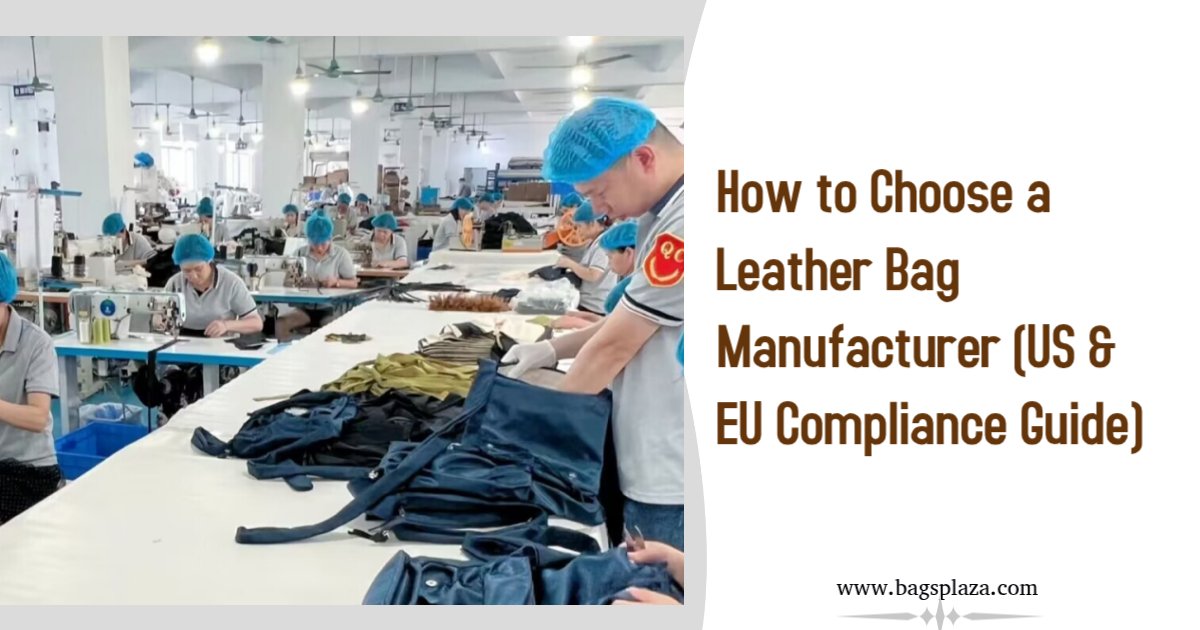
Como escolher um fabricante de bolsas de couro (Guia de conformidade EUA e UE)
Introdução
Resposta rápida:
O melhor fabricante de bolsas de couro depende do tamanho do seu pedido, da complexidade do produto e do mercado-alvo.
Escolher o fornecedor errado pode levar a falhas de conformidade, atrasos e custos inesperados.
Para a maioria das marcas americanas e europeias, as fábricas na China oferecem o melhor equilíbrio entre suporte à conformidade, capacidade de desenvolvimento e integração da cadeia de suprimentos.
Para produtos mais simples ou com custos reduzidos, regiões como o Vietnã ou a Índia podem ser consideradas, mas exigem uma avaliação e um controle de qualidade mais rigorosos.
Escolher um fabricante de bolsas de couro Para os mercados dos EUA e da UE, o processo de fornecimento é muito diferente do fornecimento para regiões menos regulamentadas. Os compradores não comparam apenas preço e aparência. Eles também precisam avaliar a conformidade química, a consistência dos materiais, o controle de documentação, os padrões de fabricação e a capacidade da fábrica de dar suporte a programas de exportação recorrentes.
Um fornecedor que parece competitivo na fase de cotação pode se tornar muito caro posteriormente se o produto falhar nos testes, não atender às expectativas de qualidade ou chegar com documentação de envio e conformidade incompleta. Atrasos na alfândega, inspeções reprovadas, reclamações de clientes e recalls de produtos podem prejudicar rapidamente tanto as margens de lucro quanto a reputação da marca.
Por isso, a escolha de um fabricante de bolsas de couro para mercados ocidentais nunca deve se basear apenas no preço. A fábrica ideal deve compreender as exigências de conformidade do mercado de destino, manter procedimentos estruturados de controle de qualidade, garantir a rastreabilidade da matéria-prima e comunicar-se de forma clara desde a amostragem até a produção em larga escala.
Na Guangzhou Herder Leather Products Co., Ltd., constatamos que os compradores geralmente obtêm melhores resultados a longo prazo quando encaram a seleção de fornecedores como um processo de controle de riscos, e não apenas como uma comparação de preços. Este guia explica o que importadores, marcas próprias, atacadistas, varejistas e compradores corporativos devem observar ao avaliar um fabricante de bolsas de couro para os Estados Unidos e a Europa.
Para quem é este guia?
Este guia foi elaborado para compradores que buscam fabricantes de bolsas de couro para mercados regulamentados, como os Estados Unidos e a Europa, incluindo:
marcas próprias de bolsas de couro estão construindo linhas de produtos em conformidade
Importadores e atacadistas que trabalham com fábricas de bolsas de couro OEM
Vendedores de comércio eletrônico que desenvolvem coleções de bolsas de couro para os mercados dos EUA/UE
Compradores corporativos que buscam bolsas de couro para o varejo, programas de brindes ou promocionais
Requisitos de conformidade EUA vs. UE
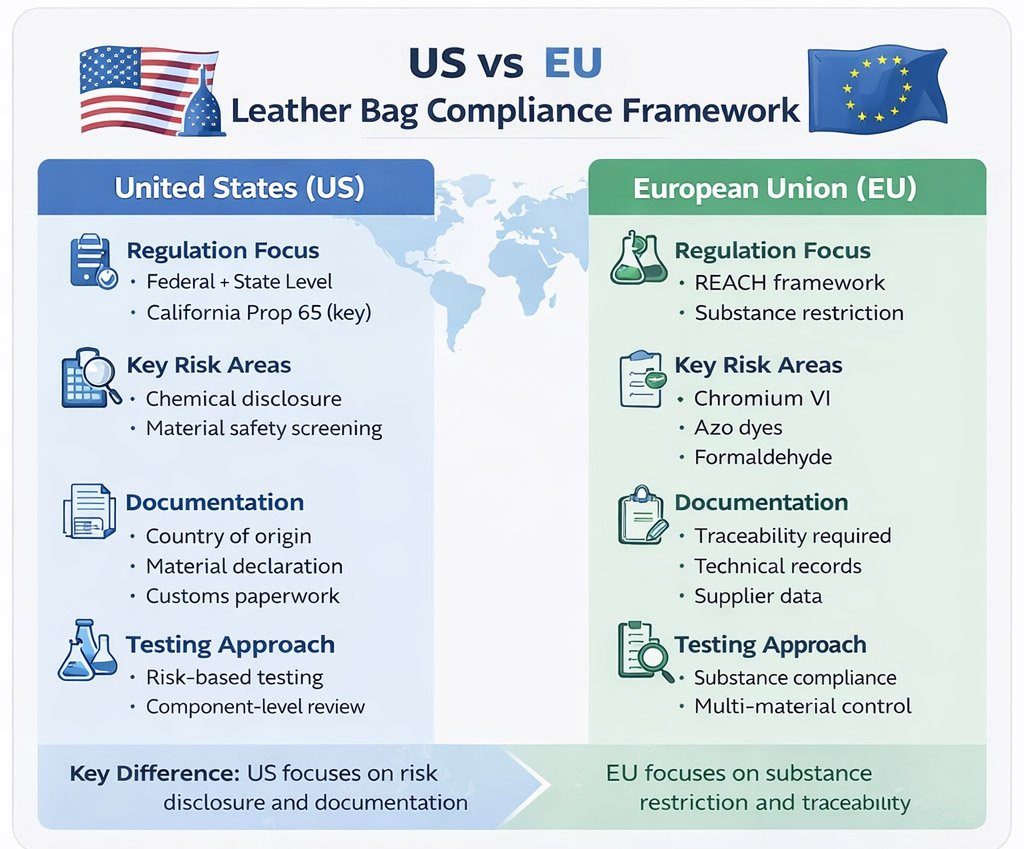
Embora ambos os mercados esperem produtos de consumo seguros e em conformidade com as normas, o quadro de conformidade não é idêntico nos EUA e na UE. Um fabricante competente de bolsas de couro deve compreender essa diferença e saber como preparar materiais, acessórios, suporte para testes e documentos de acordo com as regulamentações.
Requisitos do mercado dos EUA
Para o mercado dos EUA, a conformidade das bolsas de couro é frequentemente avaliada por meio de uma combinação de requisitos federais, necessidades de documentação alfandegária e controles químicos estaduais, quando aplicável.
Por exemplo, produtos vendidos na Califórnia podem exigir triagem de risco químico em relação a Proposição 65 da Califórnia. Dependendo da combinação de materiais e acessórios utilizados, os compradores podem precisar verificar os componentes em busca de substâncias que possam acionar requisitos de advertência ou exigir avaliação de risco adicional.
Os fabricantes também devem ser capazes de fornecer declarações de materiais precisas, marcação de país de origem e documentação de exportação para desembaraço aduaneiro. Se a bolsa for destinada a crianças ou incluir características voltadas para o público infantil, requisitos legais e de testes adicionais podem ser aplicáveis.
Na prática, uma fábrica que atende ao mercado americano deve ser capaz de identificar quais partes da bolsa podem precisar de revisão, incluindo couro, revestimentos, adesivos, pintura das bordas, forro, tintas de impressão, reforços e ferragens metálicas.
Requisitos do mercado da UE
Para o mercado da UE, a conformidade é geralmente mais orientada pela documentação e muitas vezes centra-se em Controle de substâncias relacionado ao REACH, rastreabilidade e segurança de materiais.
Bolsas de couro e acessórios relacionados podem exigir análise para substâncias restritas, tais como... cromo VI no couro, corantes azoicos, formaldeído e outros riscos químicos, dependendo da composição do material. Peças metálicas que entram em contato prolongado e direto com a pele também podem precisar ser avaliadas quanto à liberação de níquel.
Se uma bolsa incluir tecidos revestidos, materiais sintéticos, plásticos, espumas ou enfeites decorativos, análises adicionais de substâncias também podem ser relevantes, dependendo da estrutura do produto e da sua utilização prevista.
Uma fábrica que abastece o mercado da UE deve compreender que a conformidade não se resume a passar num teste geral. Trata-se de controlar o couro, os acessórios, os forros, os acabamentos, os adesivos e os materiais de embalagem, mantendo, em seguida, registos comprovativos caso o comprador, o retalhista ou a entidade de testes os solicitem posteriormente.
Por que a conformidade é importante
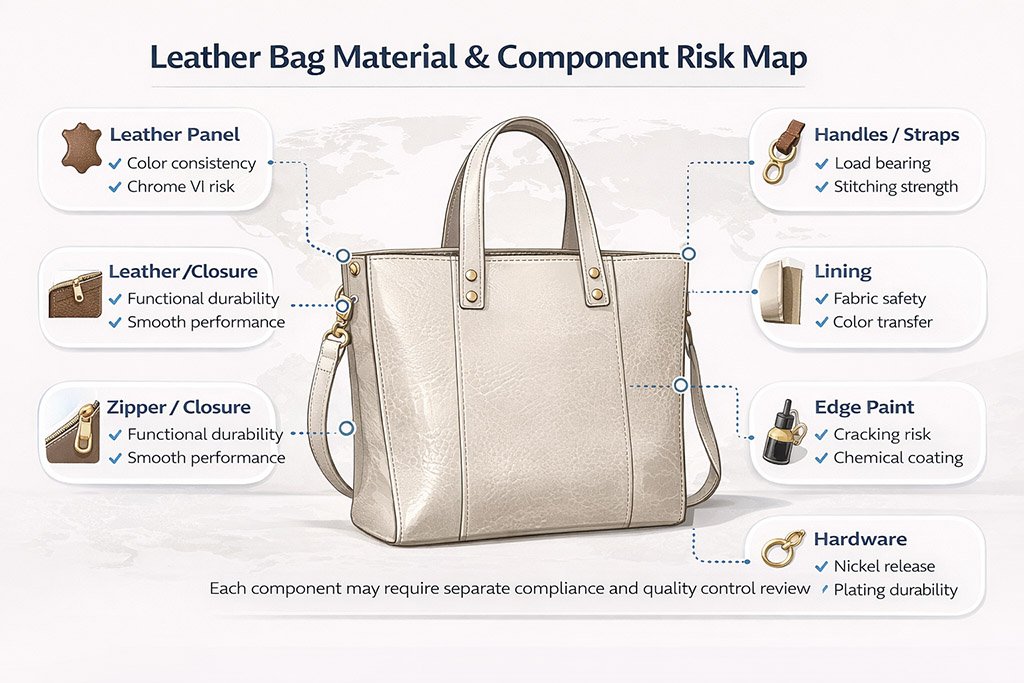
Falhas de conformidade não são meros problemas burocráticos. Elas podem afetar toda a viabilidade comercial de um programa de produtos.
Se os materiais não atenderem aos requisitos do mercado de destino, as remessas poderão ser atrasadas, rejeitadas ou sujeitas a análises adicionais. Caso os produtos não conformes já tenham entrado em distribuição, o comprador poderá enfrentar custos de retrabalho, devoluções, recalls, penalidades por parte dos varejistas ou danos às suas contas no marketplace.
Em nossa experiência, muitas fábricas conseguem produzir bolsas com aparência atraente, mas nem todas estão equipadas para dar suporte a programas de exportação que atendem aos requisitos de conformidade dos EUA e da UE. A diferença raramente é visível apenas pela foto do produto. Geralmente, ela se manifesta na qualidade da documentação, no controle de fornecedores, na conscientização sobre testes e na capacidade de resolver problemas antes que se tornem dispendiosos.
Qualificações essenciais do fabricante
Ao selecionar um fabricante de bolsas de couro para os mercados ocidentais, os compradores devem avaliar mais do que apenas o acabamento. O fornecedor deve demonstrar maturidade operacional, prontidão para exportação, rastreabilidade e controles internos estruturados.
Documentos de conformidade e auditoria a solicitar
Uma forma prática de avaliar uma fábrica é solicitar documentos em duas etapas.
Nível 1: Documentos de Acesso ao Produto e ao Mercado
Esses documentos ajudam a confirmar se o fornecedor compreende os requisitos de conformidade relacionados à bolsa, aos materiais e ao mercado de destino em si.
Os documentos recomendados incluem:
- Relatórios de testes relacionados ao REACH, quando aplicável.
• Relatórios de testes de liberação de níquel ou corantes azoicos, quando aplicáveis.
• Declarações de materiais para componentes principais
• Capacidade de marcação do país de origem
• Registros de rastreabilidade do produto
• Registros de conformidade de produtos infantis, se aplicável
Nível 2: Documentos de Gestão de Fábrica e Responsabilidade Social
Esses documentos não substituem os testes de conformidade do produto, mas ajudam os compradores a avaliar se a fábrica opera com sistemas controlados e padrões de gestão aceitáveis.
Os documentos recomendados incluem:
- ISO 9001, se disponível
• Registros de auditoria BSCI, SEDEX, SMETA ou WRAP
• Procedimentos internos de controle de qualidade
• Aprovação do fornecedor ou registros de controle de materiais recebidos
Um fabricante confiável deve ser capaz de explicar o que cada documento abrange, quando foi emitido e se se aplica a matérias-primas, produtos acabados ou sistemas de fábrica.
Experiência em exportação importa mais do que idade.
Muitos compradores perguntam há quanto tempo uma fábrica está em atividade. Isso é importante, mas a experiência em exportação para os EUA e a UE costuma ser ainda mais relevante.
Um fabricante pode ter muitos anos de experiência em produção nacional e ainda assim não possuir o conhecimento prático necessário para atender às exigências do mercado ocidental. Fornecedores com capacidade de exportação geralmente estão mais familiarizados com fichas técnicas, normas de embalagem, solicitações de rotulagem, coordenação de inspeções, consistência de documentos e o ritmo de comunicação esperado por compradores estrangeiros.
Uma pergunta mais útil não é apenas "Há quantos anos vocês estão em operação?", mas também "Há quantos anos vocês fornecem produtos para os EUA ou para a UE e que tipo de clientes vocês costumam atender?".“
Fábricas com experiência real em exportação também devem se sentir à vontade para preparar faturas comerciais, listas de embalagem, marcas de caixas e certificados ou declarações exigidos durante a preparação do embarque.
Critérios de seleção de fornecedores
Capacidade de Fornecimento
A capacidade de obter materiais tem um efeito direto na qualidade, consistência e velocidade de desenvolvimento do produto.
Um fabricante de bolsas de couro com canais de fornecimento de couro e ferragens já estabelecidos geralmente está em melhor posição para controlar a qualidade, o custo e o prazo de entrega. Também é mais provável que compreenda as diferenças entre os tipos de couro, os métodos de curtimento, a seleção da espessura, a têmpera, a estabilidade do acabamento, a consistência da cor e a combinação entre os painéis, alças, tiras e detalhes da bolsa.
Isso é importante porque a qualidade do couro pode variar significativamente entre amostras que parecem semelhantes à primeira vista. O mesmo se aplica aos acessórios. Zíperes de baixa qualidade, fechos magnéticos fracos, revestimento instável e fivelas quebradiças frequentemente geram reclamações muito tempo depois do envio dos produtos.
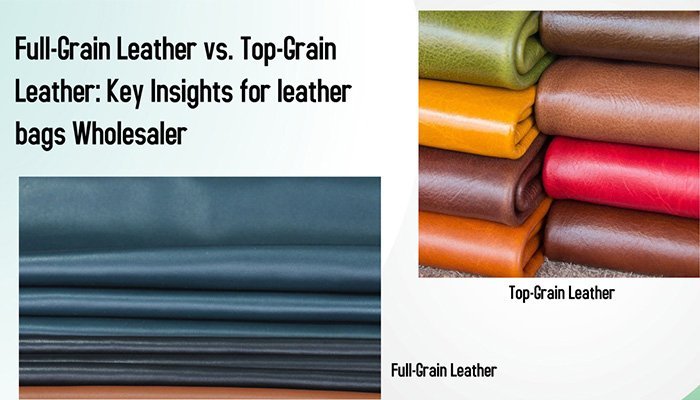
Para programas premium, os compradores devem perguntar se a fábrica pode obter materiais de qualidade superior, como... couro de flor integral ou couro de flor superior de curtumes de confiança, e se eles têm experiência no manuseio de couro importado ou europeu, quando exigido pelo posicionamento da marca.
Suporte ao Design e Desenvolvimento
Um fabricante competente deve ser capaz de trabalhar com base em fichas técnicas, folhas de dimensões, desenhos, imagens de referência e amostras físicas. Algumas fábricas são fortes no desenvolvimento de padrões a partir de arquivos técnicos, enquanto outras dependem mais da engenharia reversa de um produto existente.
Nenhuma das abordagens está automaticamente errada, mas os compradores devem entender a capacidade real de desenvolvimento da fábrica antes de prosseguir.
Algumas perguntas úteis incluem:
- A fábrica consegue criar moldes apenas a partir de uma ficha técnica?
• Podem sugerir melhorias estruturais para a estabilidade da produção?
• Será que eles conseguem identificar os riscos de construção antes do início da amostragem?
• Eles podem recomendar opções melhores de reforço, revestimento ou ferragens?
• Como eles gerenciam as revisões após o primeiro protótipo?
Para a maioria dos projetos de bolsas de couro personalizadas, a confecção de amostras geralmente leva de 2 a 3 semanas, dependendo da complexidade, dos materiais e da disponibilidade de aviamentos. Prazos muito curtos devem ser analisados com cautela, especialmente para modelos estruturados ou altamente personalizados.
Comunicação e prazos de entrega
A qualidade da comunicação é frequentemente um dos indicadores mais claros da qualidade da execução futura.
Um fabricante não precisa ter inglês perfeito, mas deve ser capaz de discutir materiais, dimensões, detalhes de costura, pintura de borda, métodos de logotipo, requisitos de embalagem, escopo de testes e questões de produção sem repetidos mal-entendidos.
Os prazos de resposta também são importantes. Uma fábrica organizada durante a fase de orçamento e desenvolvimento tem maior probabilidade de se manter organizada durante a produção. Em geral, os compradores devem esperar respostas claras dentro de 24 a 48 horas úteis para a comunicação normal do projeto.
Os prazos de entrega variam de acordo com o material, o volume do pedido e a época do ano, mas, em linhas gerais, podem ser considerados os seguintes valores:
- Desenvolvimento da amostra: cerca de 2 a 3 semanas
• Produção em massa: cerca de 4 a 5 semanas após a aprovação da amostra e confirmação do material.
Estruturas complexas, moldes personalizados, materiais importados, bordas com acabamento manual e programação em época de pico podem prolongar esses prazos.
Sistema de Garantia da Qualidade
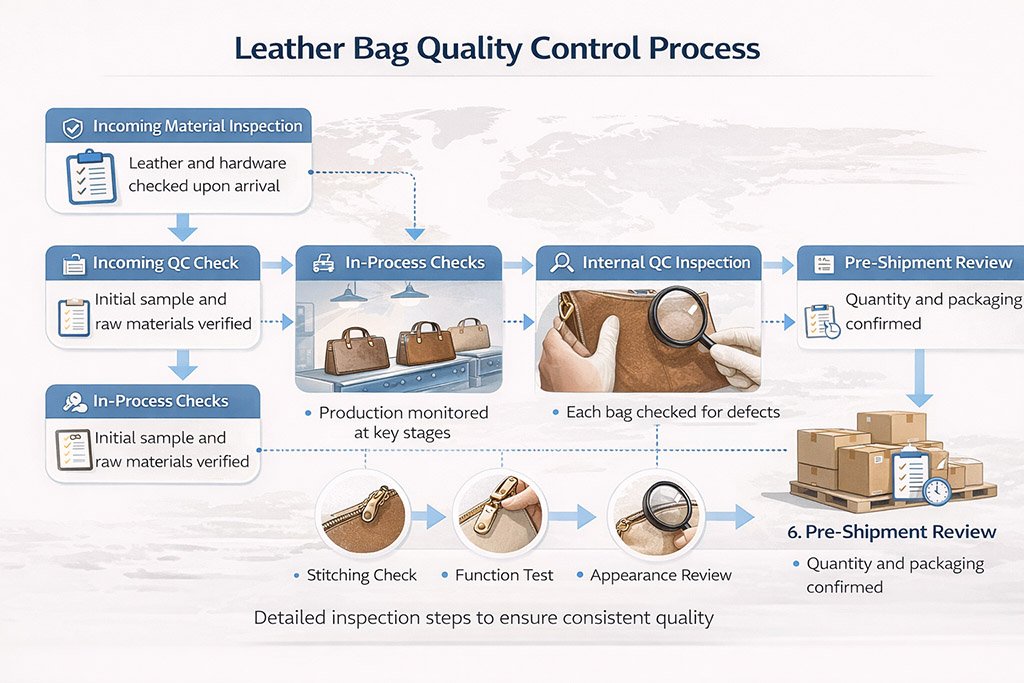
Um fabricante de bolsas de couro para os mercados dos EUA e da UE deve ter um sistema de qualidade visível e repetível, e não informal e reativo.
Os compradores devem procurar evidências de:
- Inspeção de materiais recebidos
• Pontos de verificação de produção em linha
• Padrões de inspeção final
• Conscientização sobre os Níveis de Qualidade Aceitáveis (AQL) para inspeção de remessas
• Controle de qualidade na costura, pintura de bordas, aplicação de logotipos e montagem de ferragens.
• Verificações funcionais, como movimento do zíper, desempenho do fecho, resistência da fixação da alça e teste de carga, quando necessário.
Uma fábrica competente não se limita a afirmar que inspeciona as mercadorias. Ela deve ser capaz de explicar quando a inspeção ocorre, o que é verificado, quem aprova e como os defeitos são registrados, identificados e corrigidos.
Do ponto de vista prático B2B, os compradores devem prestar atenção especial a quatro áreas que frequentemente geram reclamações recorrentes na produção de bolsas de couro: consistência da costura, acabamento da pintura nas bordas, durabilidade das ferragens e correspondência de cores entre o couro e os componentes de acabamento.
Rastreabilidade e Controle de Documentação
A rastreabilidade torna-se especialmente importante quando os compradores precisam de pedidos repetidos, revisão de reclamações ou acompanhamento de conformidade.
Bons fabricantes devem ser capazes de manter registros que conectem pedidos de compra, materiais aprovados, relatórios de testes, amostras aprovadas e produtos acabados. No mínimo, devem possuir um sistema funcional para rastrear quais materiais foram utilizados em cada pedido e quais aprovações de amostras foram vinculadas à produção.
Práticas importantes de rastreabilidade incluem:
- Correspondência entre material e pedido
• Arquivamento de relatórios de teste e acompanhamento de sua validade
• Retenção de referência de amostra aprovada
• Manutenção de registros de produção para processamento de reclamações, consistência de pedidos ou ações corretivas.
Esse tipo de documentação costuma ser negligenciado durante a seleção de fornecedores, mas torna-se crucial quando surgem disputas de qualidade, reclamações de varejistas ou problemas de consistência em novos pedidos posteriormente.
Opções de fabricação geográfica
Diferentes regiões de fornecimento oferecem diferentes vantagens. A melhor escolha depende da meta de preço do comprador, do nível de qualidade, das necessidades de conformidade, do volume de pedidos e do posicionamento da marca.
China
A China continua sendo uma das regiões fornecedoras mais consolidadas de bolsas de couro, com Guangzhou e os polos de produção vizinhos desempenhando um papel fundamental na fabricação de artigos de couro. Os compradores se beneficiam de uma cadeia de suprimentos madura, ampla disponibilidade de matéria-prima, grande capacidade de desenvolvimento e capacidade de produção escalável.
A China costuma ser uma escolha prática para marcas que precisam de desenvolvimento personalizado, fornecimento flexível, acesso estável a componentes e um equilíbrio entre custo, qualidade e escala de produção.
Os desafios potenciais podem incluir diferenças de fuso horário, variação no nível de qualidade dos fornecedores e a necessidade de uma avaliação criteriosa.
Índia
A Índia pode oferecer custos de mão de obra competitivos, uma grande base industrial e, em geral, comunicação em inglês funcional em muitas fábricas voltadas para a exportação. Pode ser uma opção interessante para compradores que buscam fornecedores com custos reduzidos ou para determinadas categorias de couro.
No entanto, as capacidades podem variar significativamente de fornecedor para fornecedor. Os compradores devem analisar cuidadosamente a velocidade de desenvolvimento, o controle da documentação, a consistência e a confiabilidade da entrega antes de se comprometerem com projetos de maior porte.
Portugal, Itália e Espanha
Esses mercados são frequentemente considerados para programas premium ou de luxo, especialmente quando a origem europeia da produção é uma parte importante da estratégia da marca. Os compradores podem se beneficiar da maior proximidade com a distribuição na UE, da menor complexidade logística intraeuropeia e do alto nível de qualidade artesanal em categorias selecionadas.
A contrapartida costuma ser um custo mais elevado e uma escalabilidade mais limitada em comparação com as grandes cadeias de suprimentos asiáticas. Essas regiões de fornecimento são geralmente mais adequadas para coleções premium, volumes menores ou histórias de marca construídas em torno da produção europeia.
Como escolher de acordo com a fase do seu negócio
Para marcas iniciantes:
Priorize fábricas que ofereçam MOQ (quantidade mínima de encomenda) mais baixa e orientações para o desenvolvimento.
Evite personalizações excessivas na primeira ordem.
Para marcas em crescimento:
Equilibrar custo, qualidade e consistência.
Escolha fábricas com fornecimento estável de matéria-prima e sistemas de controle de qualidade.
Para marcas premium:
Priorize a qualidade dos materiais, o acabamento e a conformidade.
Considere fornecedores com experiência em mercados de alto padrão ou da UE.
Um processo prático de avaliação de fornecedores
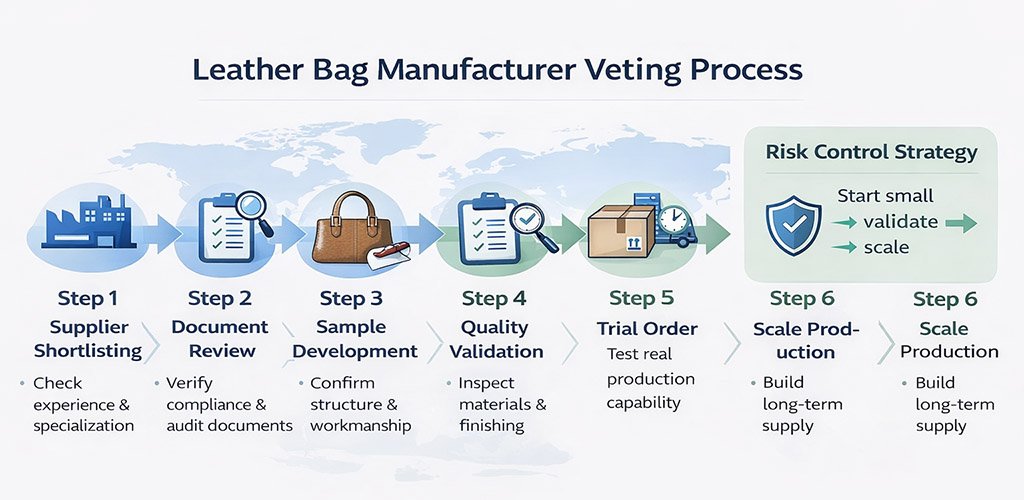
Fase 1: Seleção de Fornecedores
Comece identificando de 5 a 10 fabricantes que pareçam estar alinhados com sua categoria de produto, mercado-alvo e estrutura de pedidos.
Nesta etapa, avalie:
- Especialização de produto
• Foco na exportação
• Experiência com clientes dos EUA ou da UE
• Qualidade do site e da comunicação
• Preparação para auditorias e conformidade
• Capacidade de lidar com o volume de pedidos previsto
Fornecedores que não conseguirem discutir claramente as expectativas de conformidade para os mercados ocidentais devem ser removidos da lista o mais breve possível.
Fase 2: Revisão de Documentos
A análise da documentação deve ser detalhada, não superficial. Os compradores não devem simplesmente coletar certificados e presumir que eles tenham valor.
Ao analisar os documentos de conformidade, verifique:
- Data do relatório
• Nome do laboratório de testes
• Se o laboratório possui acreditação ISO 17025
• Descrição do produto ou material
• Se o relatório se aplica a couro, ferragens, forro, acabamentos ou produtos acabados
• Se o nome do requerente ou do fornecedor corresponde à fonte real
• Se o escopo do teste corresponde ao seu mercado de destino e à estrutura do produto
Um relatório desatualizado, genérico, incompleto ou sem relação com o material efetivamente utilizado pode ter valor muito limitado.
Fase 3: Amostragem e Validação
Antes de iniciar a produção em massa, os compradores devem desenvolver amostras com 2 a 3 fábricas pré-selecionadas, sempre que o orçamento o permitir.
A amostragem ajuda a verificar:
- Precisão do padrão
• Compreensão da construção
• Qualidade da mão de obra
• Combinação de materiais
• Eficiência de revisão
• Execução de embalagens
• Disciplina de comunicação
Para programas de maior porte, uma auditoria ou avaliação de fábrica realizada por terceiros pode proporcionar maior segurança antes do início da produção.
Comece pequeno e construa com base no desempenho.
O primeiro pedido deve ser grande o suficiente para testar a capacidade real da fábrica, mas controlado o bastante para limitar o risco comercial.
Um primeiro pedido não se resume apenas à venda do produto. É também um teste prático da coordenação interna do fornecedor, da disciplina de produção, da precisão da embalagem, da consistência da qualidade e da capacidade de resolução de problemas sob pressão.
Em muitos projetos de bolsas de couro para fabricantes de equipamentos originais (OEM) e marcas próprias, é mais sensato construir um relacionamento sólido com base em 2 ou 3 pedidos bem-sucedidos antes de aumentar significativamente o volume de produção. As fábricas também tendem a apresentar um desempenho melhor quando ambas as partes já estão alinhadas em relação a materiais, padrões de aprovação, detalhes de embalagem e rotinas de comunicação.
Estratégia de Inspeção em Três Pontos
Para novos fornecedores, um plano de inspeção estruturado reduz o risco.
Os pontos de verificação recomendados incluem:
Aprovação da amostra antes da produção
Isso estabelece o padrão de qualidade para couro, cor, dimensões, acabamento, posicionamento do logotipo, detalhes das ferragens e embalagem.
Inspeção em linha durante a produção
Geralmente, por volta de 30 a 50% de conclusão, esta é a fase em que problemas recorrentes ainda podem ser corrigidos antes que o pedido seja totalmente finalizado.
Inspeção pré-embarque
Esta é a última oportunidade para confirmar a quantidade, embalagem, acabamento, rotulagem e qualidade funcional antes do pagamento do saldo.
Para compradores que estão começando a trabalhar com fornecimento internacional, os serviços de inspeção de terceiros podem ser uma medida de segurança prática. Em nossa experiência, a inspeção prévia é especialmente valiosa para bolsas estruturadas, modelos multicoloridos, programas de personalização de ferragens e pedidos feitos pela primeira vez com novos fornecedores.
Considerações sobre custos e pagamentos
Entenda o custo total de aquisição.
O preço FOB é apenas uma parte do custo real de fornecimento.
Os compradores também devem levar em consideração o frete, os impostos, o desembaraço aduaneiro, as taxas de inspeção, a entrega local, o armazenamento e os possíveis custos de reteste ou retrabalho. Dependendo do tipo de produto, do método de envio e do mercado de destino, o custo total de desembarque pode ser consideravelmente maior do que a cotação inicial da fábrica.
As fábricas não devem ser avaliadas apenas pelo preço unitário. Uma cotação FOB ligeiramente superior de um fornecedor com maior controle de conformidade, menor risco de defeitos e melhor execução de embalagens pode resultar em um custo total menor na prática.
Condições de pagamento
As condições de pagamento internacionais mais comuns para encomendas em grande quantidade são um depósito antes da produção e o saldo antes do envio ou mediante a confirmação de que o envio está pronto, dependendo do acordo.
Em muitos programas de compra de artigos de couro, um depósito inicial de 30% a 50% é padrão, com o saldo pago após a inspeção pré-embarque e antes do envio. Os termos variam de acordo com o fornecedor, o relacionamento com o comprador e o histórico de pedidos.
Em novos relacionamentos com fornecedores, os compradores devem ter cautela ao efetuar o pagamento integral antecipado para produção em grande escala. O método de pagamento também deve estar alinhado com a praticidade comercial, o acesso bancário e a rastreabilidade dos registros comerciais.
Como verificar a conformidade com mais segurança
Mesmo que um fornecedor forneça relatórios de testes, os compradores ainda devem verificar como esses relatórios se relacionam com os produtos reais que estão sendo fabricados.
Uma abordagem mais segura inclui:
- Confirmando que os relatórios são recentes e relevantes.
• Verificar se o material testado é o mesmo que o material de produção.
• Verificar se todos os componentes críticos estão cobertos.
• Realizar testes independentes como primeira opção quando o nível de risco for alto
• Manter as amostras aprovadas e os materiais testados alinhados com a aprovação da produção.
Isso é especialmente importante para novos fornecedores, materiais de maior risco e produtos destinados a canais de varejo regulamentados.
Como regra prática, os compradores não devem confiar em um único relatório geral para toda a linha de bolsas. Couro, ferragens, forro, revestimentos e embalagens podem vir de fontes diferentes, e cada componente pode precisar de uma análise separada, dependendo do mercado e das exigências do cliente.
Erros comuns que os compradores cometem
Escolher com base apenas no preço
Preços baixos podem mascarar materiais de baixa qualidade, hardware deficiente, controle de inspeção limitado ou falta de suporte para conformidade.
Ignorar a amostragem para economizar tempo
Problemas que não são detectados na amostragem geralmente se tornam mais caros durante a produção em massa.
Fornecimento de pacotes técnicos incompletos
Dimensões imprecisas, falta de notas de construção e descrições vagas dos materiais levam a erros evitáveis.
Pagamento do saldo sem inspeção
Uma vez que a vantagem do pagamento desaparece, a correção torna-se muito mais difícil.
Comprometer-se em excesso com um fornecedor não testado
Grandes encomendas iniciais com uma fábrica não verificada aumentam tanto o risco de qualidade quanto o risco financeiro.
Tratar certificados como mera formalidade
Conclusão
Escolher um fabricante de bolsas de couro para os mercados dos EUA e da UE não é apenas uma decisão de fornecimento. É uma decisão de controle de qualidade e gestão de riscos.
O melhor fornecedor não é simplesmente aquele com o menor preço ou a promessa de entrega mais rápida. É aquele que oferece materiais em conformidade com as normas, produção controlada, comunicação confiável e qualidade consistente ao longo do tempo.
Antes de selecionar uma fábrica, os compradores devem confirmar quatro pontos:
- Os documentos de conformidade são relevantes e estão atualizados?
- As amostras correspondem aos padrões de qualidade e construção exigidos?
- O fornecedor compreende a documentação de exportação e o controle de inspeção?
- O custo real de desembarque foi calculado, e não apenas o preço FOB?
Um processo de seleção de fornecedores cuidadoso exige mais esforço no início, mas pode evitar erros dispendiosos mais tarde.
Em vez de escolher apenas com base no preço, a abordagem mais segura é avaliar seu fornecedor considerando o produto, a quantidade e os requisitos do mercado-alvo.
Podemos ajudá-lo a revisar seu projeto, avaliar os riscos de conformidade e recomendar a solução de fabricação mais adequada. Entre em contato conosco para obter um orçamento detalhado, sugestão de quantidade mínima de pedido (MOQ) e um plano de produção personalizado para o seu projeto. Contamos com mais de 18 anos de experiência na fabricação de artigos de couro.
Perguntas frequentes
Que documentos um fabricante de bolsas de couro deve fornecer para projetos nos EUA e na UE?
No mínimo, os compradores devem solicitar os relatórios de testes de materiais relevantes, declarações de materiais, registros de rastreabilidade e quaisquer documentos de auditoria de fábrica disponíveis. O conjunto exato de documentos depende da estrutura da bolsa, do mercado-alvo, da composição dos materiais e se o projeto envolve produtos infantis ou normas específicas do varejista.
Por que a conformidade com o regulamento REACH é importante para bolsas de couro vendidas na Europa?
A análise relacionada ao REACH ajuda os compradores a avaliar se o couro, os acessórios, os forros, os revestimentos, os adesivos e os acabamentos podem conter substâncias restritas que possam criar riscos de importação, varejo ou segurança do produto no mercado da UE.
A que questões de conformidade com as normas dos EUA os compradores devem estar atentos ao adquirir bolsas de couro?
Para projetos nos EUA, os compradores devem estar atentos à segurança dos materiais, declarações precisas, marcação de país de origem, documentação alfandegária e quaisquer requisitos químicos estaduais aplicáveis, como a triagem da Proposição 65 da Califórnia, quando pertinente.
Devo testar as matérias-primas ou as embalagens prontas?
Em muitos projetos, ambos os níveis podem ser importantes. Os testes de materiais ajudam a controlar os riscos antes da produção, enquanto a revisão do produto final ajuda a confirmar se a bolsa final corresponde à construção aprovada, à seleção de materiais e aos requisitos de mercado pretendidos.
Como posso verificar se um fabricante de bolsas de couro realmente tem experiência em exportação?
Os compradores devem questionar o fornecedor sobre seus principais mercados de exportação, tipos de clientes, processo de documentação, fluxo de trabalho de amostragem e experiência com dossiês técnicos, auditorias, inspeções e documentação de embarque. Uma experiência real em exportação geralmente se reflete na qualidade da comunicação, no controle de documentos e na capacidade de resolução de problemas.
Quantas amostras devo solicitar antes de escolher um fornecedor?
Para programas personalizados, muitos compradores comparam de duas a três fábricas pré-selecionadas. Isso proporciona uma visão mais realista da qualidade do trabalho, da comunicação, do gerenciamento de revisões, da eficiência do desenvolvimento e da compreensão que a fábrica tem das suas necessidades.
O que devo verificar ao analisar os relatórios de testes de uma fábrica?
Os compradores devem verificar a data do relatório, o nome do laboratório de testes, o status de acreditação, a descrição do material, os itens testados, o nome do solicitante e se o relatório corresponde aos componentes reais usados na bolsa. Um relatório genérico ou desatualizado pode ter valor limitado.
Qual é um prazo razoável para a produção de amostras e em larga escala de bolsas de couro?
Para muitos projetos de bolsas de couro personalizadas, o desenvolvimento da amostra pode levar de 2 a 3 semanas, enquanto a produção em massa pode levar de 4 a 5 semanas após a aprovação final e a confirmação do material. Os prazos de entrega reais dependem da complexidade do design, da quantidade do pedido, da disponibilidade do material e da época do ano.
Por que a rastreabilidade do fornecedor é importante na produção de bolsas de couro?
A rastreabilidade ajuda a conectar materiais aprovados, pedidos de compra, amostras, relatórios de testes e produtos acabados. Isso se torna importante ao lidar com pedidos repetidos, reclamações de qualidade, acompanhamento de conformidade ou dúvidas de varejistas após o envio.
Devo sempre escolher a fábrica com o preço mais baixo?
Não necessariamente. Um preço mais baixo pode mascarar materiais de qualidade inferior, hardware de qualidade inferior, controle de inspeção mais frágil ou falta de suporte para conformidade. Os compradores devem avaliar o custo total de aquisição, o risco de qualidade e a confiabilidade da execução, e não apenas o preço unitário FOB.
Qual a maneira mais segura de começar a trabalhar com um novo fabricante de bolsas de couro?
Comece com um pedido inicial controlado, mantenha as aprovações documentadas, alinhe claramente os materiais, os padrões de mão de obra e os detalhes da embalagem e utilize pontos de verificação de inspeção antes do pagamento final. Isso reduz o risco comercial e demonstra se o fornecedor pode manter uma cooperação a longo prazo.
Preciso de uma inspeção de terceiros para meu primeiro pedido?
Para muitos pedidos iniciais, especialmente com um novo fornecedor, uma inspeção por terceiros é uma forma prática de reduzir riscos. Ela pode ajudar a confirmar a quantidade, a qualidade da fabricação, a embalagem, a rotulagem e o funcionamento antes do envio e da liberação do pagamento final.